EIA Storage Update: +20 Bcf vs +25 Bcf Est
Signal: Slight Bullish
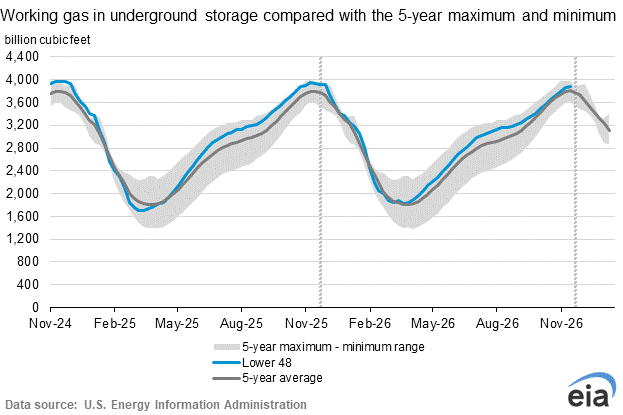
As we navigate the fall shoulder season with limited weather-driven demand, the EIA reported an injection of 20 Bcf for the week. This was 5 Bcf smaller than the consensus estimate of +25 Bcf. With total inventories now at 3882 Bcf, storage sits modestly above the 5-year average, providing a comfortable buffer and represents a modest deficit compared to last year.
Near-normal weather expectations are keeping weather-related volatility subdued. UNG ETF moved +0.00% around the EIA release, comparing one-minute bar closes ending 11/19/2026, 10:29:00 AM EST and 11/19/2026, 10:45:00 AM EST (1 minute before to 15 minutes after the published release time; source: Yahoo Finance). This ETF proxy is not a futures measurement and does not establish that the release caused the move.
Why This Matters:
This slight bullish surprise puts upward pressure on gas prices and, by extension, ERCOT power pricing.
Disclaimer: Alden Energy provides this market update for general informational purposes only. It is not an offer or solicitation to buy or sell energy commodities, futures, or options, and it is not investment or trading advice. Data and estimates are drawn from sources believed to be reliable, but their accuracy and completeness are not guaranteed. Estimates and opinions reflect information available when this update was prepared and are subject to change without notice. Forecasts and market interpretations are uncertain; past performance does not guarantee future results. Readers are responsible for their own decisions and should obtain advice appropriate to their circumstances.
Working gas in underground storage, Lower 48 states, Released 11/19/2026
Summary
Working gas in storage was 3,882 Bcf as of Friday, November 13, 2026, according to EIA estimates. This represents a net increase of 20 Bcf from the previous week. Stocks were 66 Bcf less than last year at this time and 80 Bcf above the five-year average of 3,802 Bcf. At 3,882 Bcf, total working gas is within the five-year historical range.
Follow Us
Read Our Latest News